
Machine Learning Classifier Identifies 20 Subtypes of T-ALL
A new machine-learning classifier developed by researchers from the University Hospital Schleswig Holstein, Campus Kiel enables a more detailed and consistent molecular classification of T-cell acute lymphoblastic leukemia (T-ALL). The study, recently published in HemaSphere, identifies 20 gene expression based subtypes across children and adults and extends the ALLCatchR approach previously developed for B-cell ALL.
T-ALL is a biologically diverse disease, with different genetic alterations and developmental states contributing to its molecular subtypes. To establish a robust classification framework, the researchers analyzed the largest RNA sequencing data set to date comprising 2,314 T-ALL samples from 15 cohorts, covering patients from 0.8 to 90.8 years of age. The analysis identified 17 main gene-expression clusters and three additional subclusters. “ALLCatchR2, now systematically classifies T-ALL into 20 gene expression subtypes with 92.7% of predictions matching the corresponding genomic driver aberrations. This helps us capture the biological diversity of T-ALL in a more consistent way and provides a practical tool for analyzing individual samples,” explains Dr Thomas Beder, first author of the study. The tool also estimates the proportion of leukemic blasts and provides information on the developmental state of the cells, indicating distinct developmental trajectories of T-ALL subtypes.
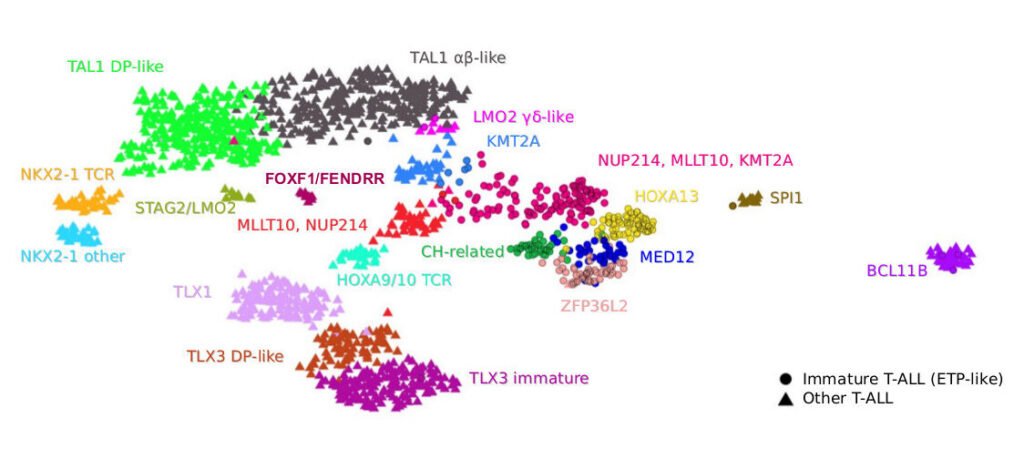
PD Dr Martin Neumann, shared last author of the study, adds: “For clinical practice, a more precise and reproducible molecular classification of T-ALL is an important step. ALLCatchR2 could help us better characterize individual patients and, in the future, investigate whether specific molecular subtypes are associated with differences in prognosis or offer new treatment strategies.” The analysis also revealed a previously unrecognized T-ALL subtype associated with mutations in IDH2 and DNMT3A, genes linked to clonal hematopoiesis. This subtype was found in 8.9% of adults and in 39.5% of patients over 50 years of age in the analyzed cohorts. The finding adds to evidence that the biology of T-ALL is influenced by individual genetic alterations on the one side, but also by the developmental state and cellular origin of the leukemia.
“The analysis shows that gene-expression patterns in T-ALL reflect the underlying genetic alterations and the developmental state of the leukemic cells. This gives us a more comprehensive view of how different T-ALL subtypes arise and provides a basis for integrating molecular and developmental features into future classification systems”, says shared last author Dr Lorenz Bastian. ALLCatchR2 is available as a free R package and extends the original ALLCatchR framework from B-ALL to both B- and T-lineage disease. The work is part of the Clinical Research Unit CATCH ALL (KFO 5010) at the UKSH, Campus Kiel and is embedded in the research activities of the University Cancer Center Schleswig-Holstein (UCCSH).
The new study builds directly on the previous CATCH ALL work on machine-learning-based molecular classification of B-ALL. Read our previous article on ALLCatchR and more precise molecular diagnostics of acute lymphoblastic leukemia here.